Vinyl, Mesh, HDPE, or Canvas? How to Choose the Right Banner Material
Start with the installation, then choose the material. This practical guide helps you match your banner to its location, purpose, and artwork.
Begin with the Installation—not the Material Name
Before choosing a banner, determine whether it will be displayed indoors or outdoors, whether it will hang against a wall or attach to a fence, and whether it is intended for a short promotion or a longer display. Consider how far away people will stand and how you plan to mount it.
These answers are more useful than simply choosing the heaviest or least expensive material. A banner that works beautifully on a storefront wall may not be the best choice for an exposed fence, while a textured display print may be unnecessary for a temporary sales promotion.
The Devil Decals banner catalog lets you compare materials before entering dimensions, artwork, quantity, and finishing choices.
Vinyl Is the Versatile Everyday Banner
Custom vinyl banners are a flexible starting point for storefronts, events, job sites, sponsorships, sales, and grand openings. Devil Decals offers 13 oz, 15 oz, and 18 oz vinyl configurations. The lighter option is practical for common displays, while heavier materials provide additional body. Supported 18 oz configurations also offer double-sided printing.
Start with vinyl when you need a general-purpose indoor or outdoor banner, a solid printed surface, or multiple finishing choices. It is a useful candidate for designs containing photographs, gradients, and detailed branding.
The correct weight and finishing still depend on the installation. If the banner will be unusually large or exposed, describe the location before ordering.
Mesh Is Better Suited to Exposed Fences and Airflow
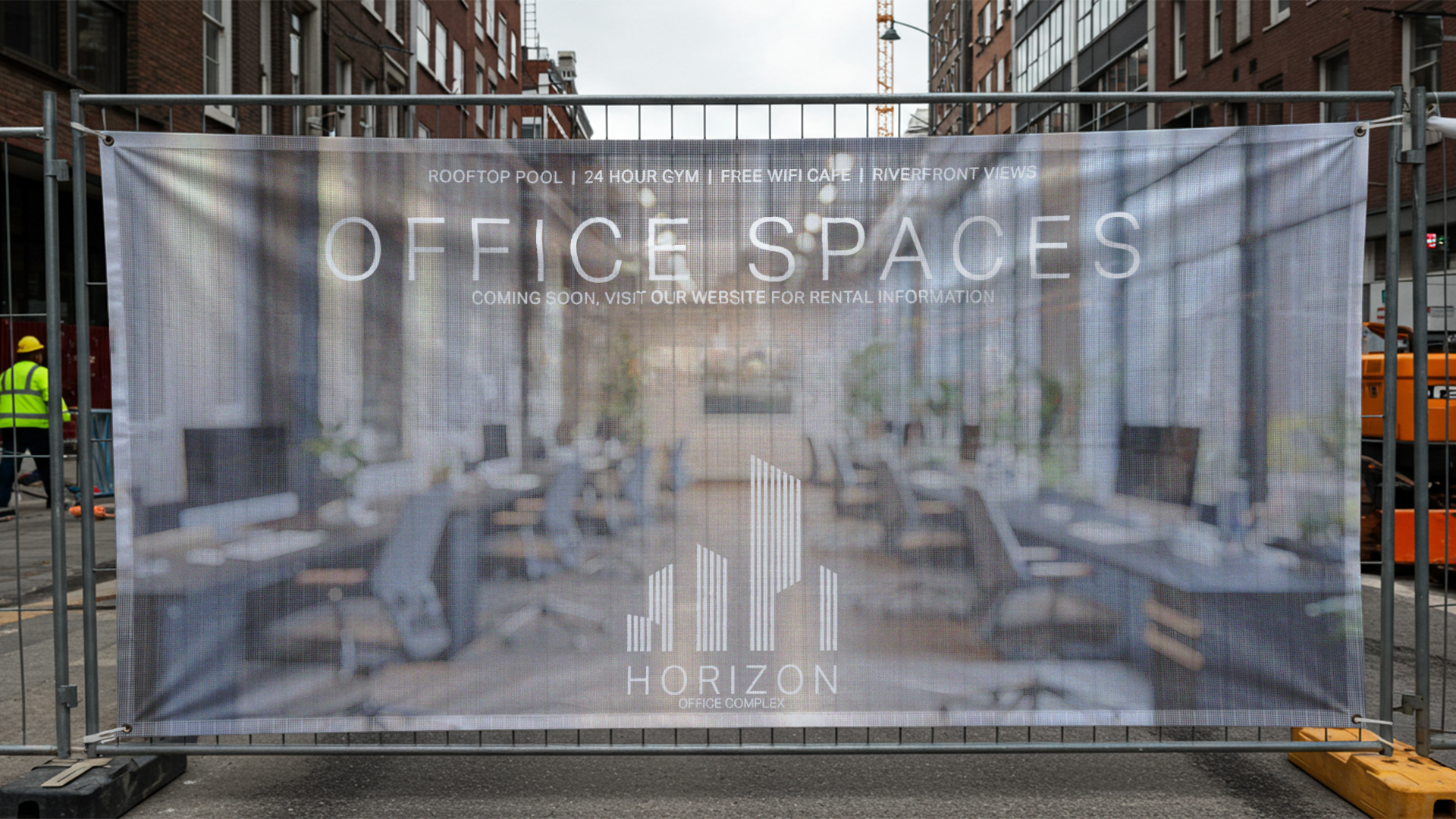
A mesh banner contains perforations that allow some air to pass through the printed surface. This makes mesh a better candidate than solid vinyl for fences, construction sites, and other exposed locations where airflow matters.
Those perforations also affect appearance. Mesh does not have the same visual density as solid vinyl, so emphasize bold headlines, strong color contrast, larger lettering, simple calls to action, and logos without extremely fine details.
Mesh should not be treated as permission to ignore installation conditions. Banner size, mounting points, hardware, surrounding structures, and local weather still matter. Describe an unusually exposed installation to Devil Decals before production.
HDPE and Canvas Solve Different Problems
HDPE banners are lightweight, water-resistant, and intended primarily for economical short-term or light-duty displays. They can be useful for temporary promotions, events, and budget-conscious messaging where a heavier banner is unnecessary.
Printed canvas occupies a different category. Devil Decals' canvas option uses an 11 oz poly-cotton material with a gesso finish. Its textured presentation surface makes it better suited to artwork, portraits, decor, and branded display graphics than to general outdoor signage.
Choose HDPE for lightweight temporary messaging, canvas when texture and presentation are central, vinyl for general banner use, and mesh for exposed fence-style displays where airflow matters.
Prepare the Design for Its Final Viewing Distance
Prepare banner artwork around its finished proportions. A square social-media graphic cannot fill a wide banner without cropping, empty space, or redesign. Use the original logo or highest-resolution image available and keep important text away from finished edges and mounting hardware.
Image resolution should be evaluated at the intended print dimensions and viewing distance—not merely by how sharp the file looks on a phone. Adobe's print-resolution guidance explains why large-format graphics viewed farther away can have different resolution needs than close-viewed prints. See the Adobe references below for resolution and bleed guidance.
Include bleed only when the builder, template, or production instructions call for it. Confirm whether your design will be viewed from one side or two, and select finishing according to how the banner will actually be mounted.
- Start with the installation location and expected viewing distance.
- Use vinyl as the general-purpose starting point; consider mesh for exposed fences.
- Reserve HDPE primarily for economical short-term displays and canvas for textured presentation graphics.
- Communicate finished dimensions and use strong contrast with readable contact information.
- Choose only finishing options supported by the selected configuration.
- Ask for guidance when a display is unusually large, exposed, or structurally complicated.
Turn Your Idea Into a Finished Product
AI can help create the idea. Devil Decals can help prepare it for real production. Submit your artwork, concept, sketch, or inspiration and we will help determine what is needed to print, cut, or apply it properly.
About the Author
Rob Macedonio is a U.S. Marine Corps veteran, heavy-equipment professional, entrepreneur, and founder of Devil Decals LLC. His work combines practical production experience, graphic design, digital fabrication, business operations, and emerging technology.